Why Every Bottle Is Part of Our Quality Promise
At OLEA, quality does not end when the oil leaves the press. It ends the moment you break the seal on the bottle. Everything that happens in between — clarification, container selection, sealing, storage — is treated in our production process with the same discipline as the harvest itself, because a great olive oil poorly packaged is simply a great olive oil in the process of being ruined.
Protecting What the Harvest Already Achieved
Olive oil is a living food. Its monounsaturated fats and the phenolic compounds responsible for its aroma, pungency, and much of its health value begin to degrade the moment the oil is exposed to light, oxygen, or heat. This is not a marketing claim — it is a well-documented finding across olive oil research from the Mediterranean’s leading producing regions, and it shapes every packaging decision we make. An oil that was harvested with care and pressed at the right temperature can still lose its character within months if it is bottled or stored carelessly afterward.
Why We Choose Dark Glass and Tin
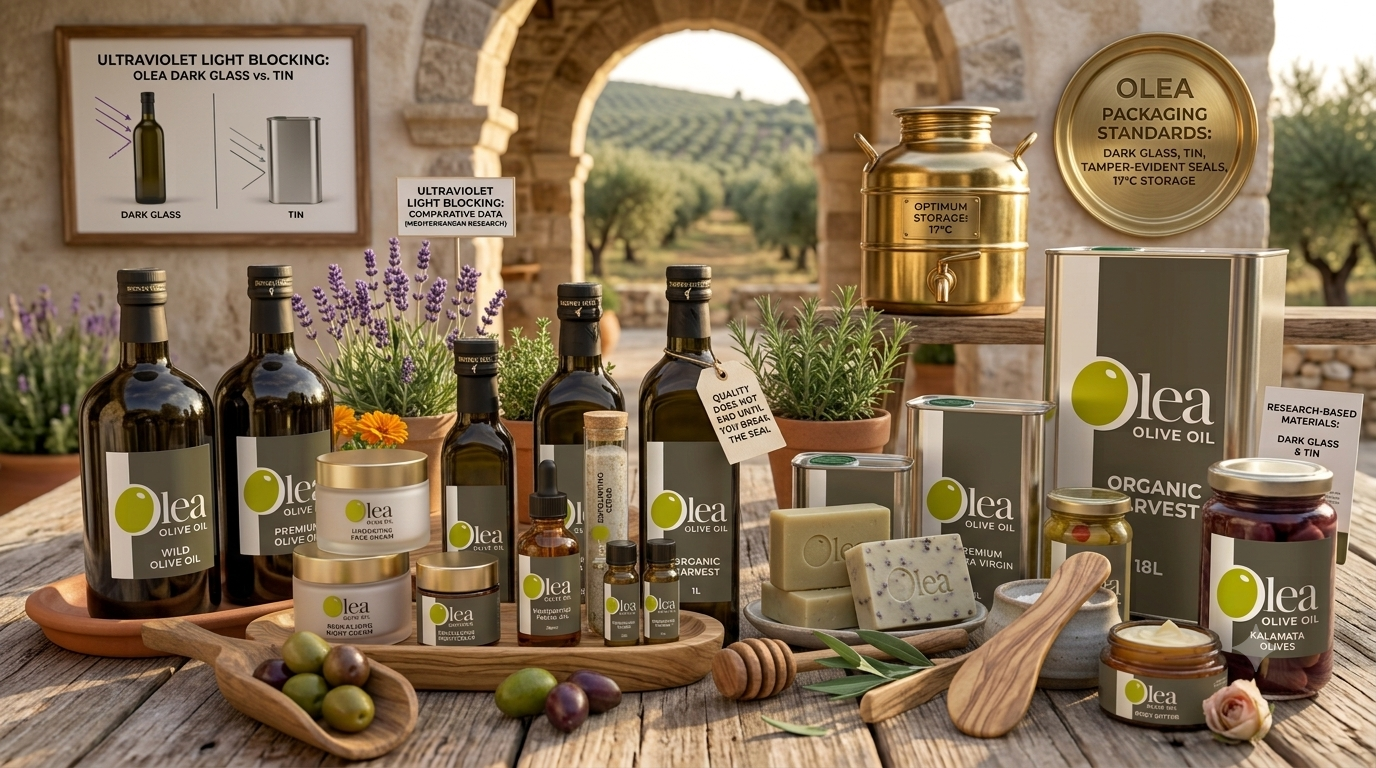
We package our olive oils exclusively in dark glass and tin — never in clear glass or untreated plastic. This is a deliberate choice grounded in comparative packaging research: dark glass blocks the great majority of the ultraviolet light that drives photo-oxidation, while tin blocks light entirely and adds resistance to breakage during transport. Both materials are chemically inert, meaning they do not react with or leach into the oil over time, unlike some plastics, which have been shown in independent studies to slowly transfer compounds into oil during long storage. For a product built around freshness and phenolic richness, we consider this a non-negotiable standard rather than a stylistic preference.
A Measured Approach to Clarification
Before any OLEA oil is bottled, it is rested to allow natural sedimentation, then carefully clarified to remove residual moisture and olive particles. We treat this step the way Mediterranean producers with the strongest quality reputations do: as a balance rather than a shortcut. Too little clarification leaves an oil unstable for the shelf life our customers expect; too aggressive a process strips away aroma. Our goal at every stage is an oil that reaches your bottle exactly as it left the press — bright, stable, and true to its harvest.
Built Around a Simple Number: 17°C
Every packaging and storage decision we make is built around a single reference point: olive oil kept in the dark at around 17°C holds its quality far longer than oil left exposed to light or warmth, where shelf life can fall to as little as three months. This is why our bottles and tins are sized deliberately — from a 250 ml bottle of Wild Olive Oil to an 18-litre tin for professional kitchens — so that once a container is opened, its contents are used within a timeframe that protects quality, rather than sitting half-full and deteriorating on a shelf.
A Closure You Can Trust
Every OLEA bottle and tin is fitted with a closure that cannot be reused or resealed undetected once broken — the same principle behind the tamper-evident packaging standards now required across the European Union for retail olive oil. It exists for one reason: so that what you pour from an OLEA bottle is provably, verifiably what left our facility, with nothing added and nothing exchanged along the way.
The OLEA Promise
Packaging, to us, is not the last step of production — it is the guarantee behind everything that came before it. Careful harvesting and pressing mean nothing if the oil is allowed to degrade before it reaches your kitchen. That is why every material, every seal, and every bottle size we choose is decided against the same question: does this protect what the Aegean grove and our press have already given this oil? If the answer is anything other than yes, we don’t use it.
OLEA OLIVE OIL