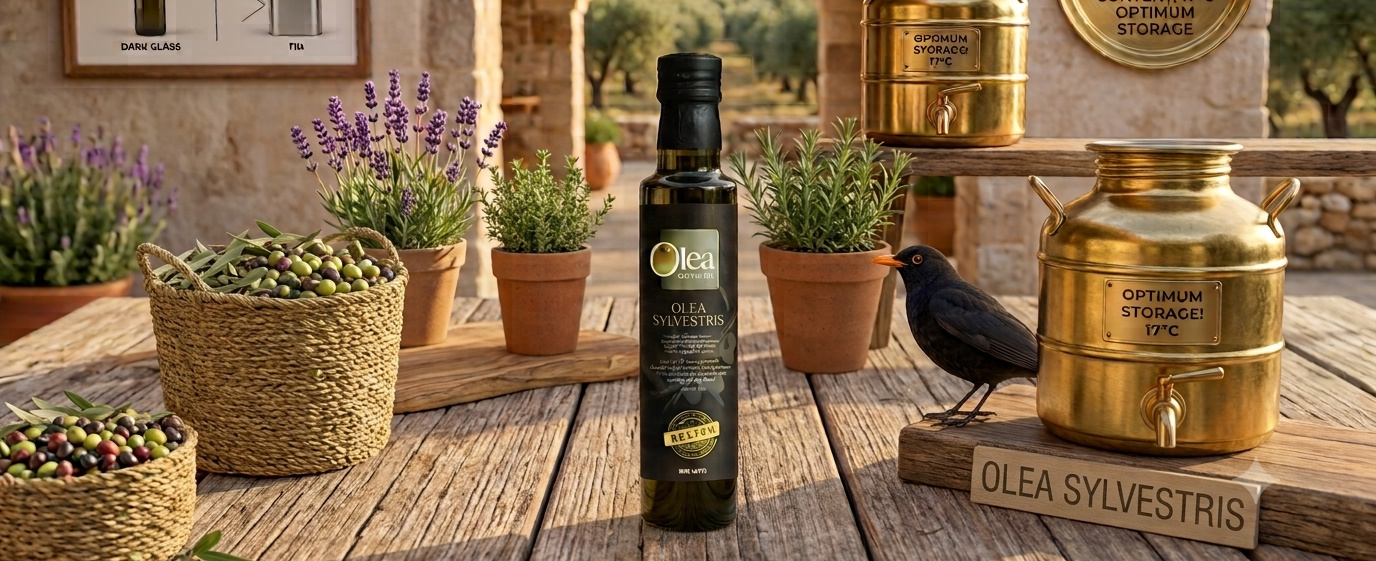
Wild olive oil is pressed from Olea europaea var. sylvestris, commonly known as the oleaster or wild olive tree. Regarded as the ancestor of every cultivated olive variety grown today, this tree grows on its own throughout the Mediterranean basin — never grafted, never pruned, and never planted by hand. It goes by different names depending on the region: “delice zeytini” in Turkey, “acebuche” in Spain, and “oleaster” in Italy and Greece.
Because these trees grow wild on unirrigated, uncultivated mountainous land, the harvest is done entirely by hand — mechanized picking is not possible. Yield is also markedly lower than that of cultivated olives; some producers report needing as much as 12 kilograms of olives to produce just 1 kilogram of oil. This combination of low yield and difficult harvesting conditions makes wild olive oil one of the rarest and most expensive olive oil categories in the world, with boutique-scale producers commanding high prices per liter.
The most significant difference highlighted by the scientific literature lies in its chemical composition. Studies conducted in Greece, Spain, Portugal, Tunisia, and Algeria show that wild olive oil carries a higher concentration of phenolic compounds and antioxidant activity than oil from cultivated olives. The main source of this is oleuropein, the compound responsible for both the oil’s strong antioxidant effect and its characteristically sharp taste. It is also notable for its high oleic acid content and its richness in tocopherols (vitamin E) and sterols.
This high phenolic content also comes through in flavor: an intense, sharp, peppery profile that can leave a slight burning sensation in the throat. For this reason, wild olive oil is typically consumed raw — heat during cooking destroys much of its valuable phenolic content.
There is no current, globally recognized price benchmark for wild olive oil comparable to the standard olive oil indices tracked by major bodies such as the IOC, Tridge, or IndexMundi, simply because the product occupies such a small, boutique niche. Even so, given its low yield, demanding harvest, and limited supply, it is widely regarded within the industry as one of the most expensive olive oils in the world.